.png)




Why IT Consulting Firms Need Specialized Digital Marketing
IT consulting firms require specialized digital marketing because generic marketing agencies do not understand the managed services buyer psychology, the high switching costs that keep prospects locked into current providers, or the five to fifteen year buying cycle that makes each lead worth hundreds of thousands of dollars in lifetime revenue.
I have spoken with well over a thousand MSP and IT consulting business owners. The pattern is always the same. They hire a local marketing agency — someone they know, someone who got recommended, whatever. The agency takes a shotgun approach: tries cold calling, email blasts, social media, some SEO, maybe Google Ads. After six to twelve months and $30,000 to $100,000 spent, the campaign has produced vanity metrics and zero clients.
The problem is not that digital marketing does not work for IT consulting. It works extremely well — when it is done by people who understand the industry. The problem is that generic agencies do not understand your service, do not understand why people buy it, and do not have the targeting data or proprietary assets needed to reach your ideal client efficiently.
From what I have seen, MSPs and IT consultancies tend to put their best foot forward when it comes to trusting service providers. You assume they will do good work because that is how you operate. But agencies without industry expertise are developing their assets on your dime — using hundreds of thousands of dollars in experimentation that should not be your expense.
Key Takeaway: IT consulting firms fail at marketing not because marketing does not work, but because generic agencies lack the industry expertise, buyer psychology understanding, and targeting data needed to generate managed services leads efficiently.
What Digital Marketing for IT Consulting Actually Looks Like
Digital marketing for IT consulting companies centers on three core channels — local SEO with Google Business Profile optimization, targeted Google Ads on exact-match keywords, and a conversion-optimized website — because these are the only channels that consistently reach business owners actively searching for IT consulting and managed services.
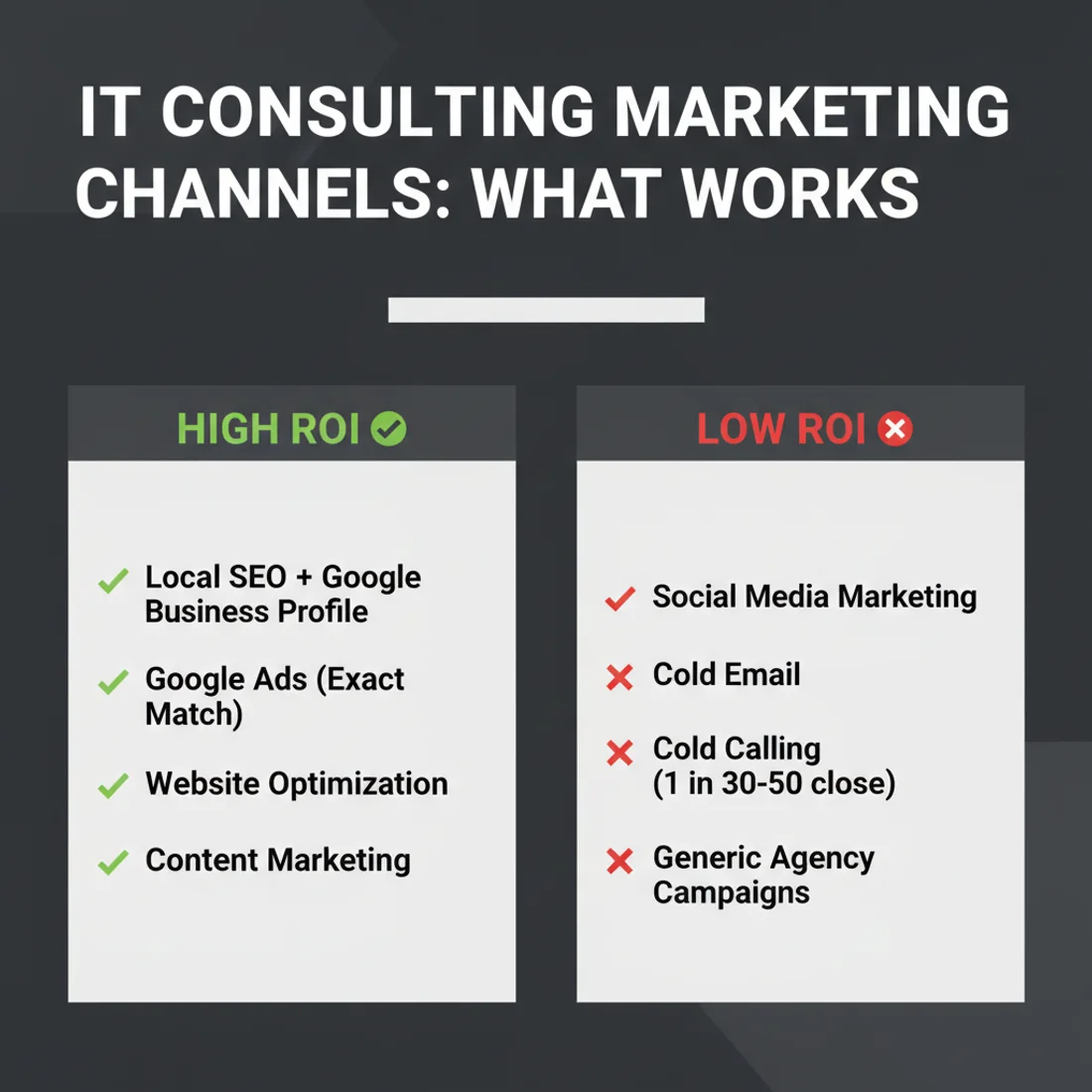
Let me cut through the noise. There are a dozen marketing channels people will try to sell you on. Most of them are a waste of money for IT consulting firms. Here is what actually works and what does not:
Local SEO and Google Business Profile — Effectiveness for IT Consulting: High — core foundation — Why: Low barrier to entry, blue ocean opportunity, compounds over time
Google Ads (Search) — Effectiveness for IT Consulting: High — when done right — Why: Reaches high-intent prospects but requires MSP-specific expertise
Website optimization — Effectiveness for IT Consulting: High — multiplies everything — Why: Converts traffic from all channels, compounds with content
Content marketing and SEO — Effectiveness for IT Consulting: Medium-high — long-term play — Why: Builds authority and generates organic traffic over 6-12 months
Social media marketing — Effectiveness for IT Consulting: Low — for most IT firms — Why: Reaches people who already have an IT provider and are not looking to switch
Cold email — Effectiveness for IT Consulting: Very low — near zero locally — Why: Only works for hyper-specialists with unique solutions, never for local services
Cold calling — Effectiveness for IT Consulting: Very low — 1 in 30-50 close rate — Why: Generates meetings but almost no conversions, extremely expensive per acquisition
The hierarchy is simple. First, optimize for local discovery — Google Maps, reviews, distance, team visibility, and offer clarity. Once you are optimized in your city, expand to adjacent areas. Then add Google Ads. Everything else comes after these three are working.
Key Takeaway: Focus on the three channels that actually work for IT consulting: local SEO, Google Ads, and website optimization. Social media, cold email, and cold calling consistently underperform for local IT services companies.
SEO for IT Consulting: Local Strategy vs Global Strategy
IT consulting SEO strategy should prioritize local search optimization targeting city-specific keywords like "IT consulting [city]" and "managed IT services [city]" over global SEO tactics, because local search captures prospects within a six to seven mile radius who have genuine buying intent and convert at dramatically higher rates.
There is a fundamental misunderstanding about SEO in the IT consulting world. Most IT firm owners think SEO means ranking for broad terms like "managed IT services" or "IT consulting" nationally. That is global SEO. It is extremely competitive, takes years, costs a fortune, and 95 percent of available SEO talent is poor quality at executing it.
Local SEO is the opposite. It is accessible, it compounds faster, and it targets the people who are actually going to buy from you — businesses within your geographic service area.
Local SEO: The Foundation
- Google Business Profile optimization—Your GBP is your strongest asset. Optimize categories, add photos, post weekly, and systematically collect reviews. This alone can put you in the local pack for your primary keywords.
- City-specific service pages—Create dedicated pages targeting "[service] in [city]" for every city you serve. "IT consulting in Aurora" is a different page from "IT consulting in Denver." Each targets a different geographic market.
- Local citations—Get listed in Chamber of Commerce directories, BBB, local business associations, and industry-specific directories. Consistent NAP (name, address, phone) across all listings strengthens your local authority.
- Review strategy—A competitor with 100 reviews and a 4.8 rating is a fortress. If you have five reviews, fixing that is your highest-impact SEO activity. Every satisfied client should be asked for a review.
When Global SEO Makes Sense
Global SEO only makes sense for IT consulting firms that have already dominated their local market and want to build broader authority. Publishing in-depth content about IT consulting topics, industry trends, and technical guides builds domain authority that strengthens your local rankings too. But it should never be your starting point.
The trap is that some agencies sell "SEO" and only do global content marketing. They write generic blog posts, report on keyword rankings for terms nobody in your city searches, and never touch your Google Business Profile. That is not SEO for IT consulting — it is busywork that generates vanity metrics.
Key Takeaway: Prioritize local SEO targeting city-specific keywords over global SEO. Optimize your Google Business Profile, create city-specific service pages, build local citations, and generate reviews before investing in broader content marketing.
Google Ads for IT Consulting Services: Getting the Targeting Right
Google Ads for IT consulting requires exact-match and phrase-match keyword targeting on high-intent local search terms, dedicated landing pages for each service offering, and strict conversion filtering that feeds only qualified leads back into the algorithm, with a minimum monthly budget of three to five thousand dollars to generate meaningful data.
Google Ads can be incredibly effective for IT consulting firms — or incredibly expensive with nothing to show for it. The difference is entirely in how the campaigns are set up and managed.
You really do not want Google in your Google Ads account. I know that sounds strange, but Google's representatives will push you toward broad match keywords, automated bidding, and settings that maximize Google's revenue — not your leads. They will set things to broad match and burn through your budget showing ads to people searching for "IT careers" when you want "IT consulting services."
- Use exact match and phrase match only—Never broad match. Ever. Broad match for IT consulting will show your ads for "IT jobs," "computer repair," "tech support chat," and dozens of other irrelevant searches.
- Target high-intent local keywords—"IT consulting [city]," "managed IT services [city]," "IT support for business [city]." These reach people who are actively looking for what you sell.
- Build dedicated landing pages—Each ad group should point to a specific landing page about that service, not your homepage. If the ad promises managed IT services, the landing page must be about managed IT services. Message alignment is everything.
- Set up proper conversion tracking—Track form submissions and phone calls. Do not count page views or button clicks as conversions. And manually filter out junk leads before feeding conversion data back to Google.
- Start with $3,000 to $5,000 per month—Below this threshold, you do not generate enough data to optimize. Above it, you can test multiple keyword groups and landing pages simultaneously.
What Good ROAS Looks Like
If you are spending $5,000 per month on Google Ads and generating 10 qualified leads, your cost per lead is $500. If you close 3 of those leads and each client is worth $2,500 per month on a multi-year contract, you have generated $7,500 in monthly recurring revenue from $5,000 in ad spend. Over the client's lifetime, that is $720,000 from $5,000. The math works — if the targeting is right.
Key Takeaway: Run Google Ads with exact-match keywords, dedicated landing pages, and strict conversion filtering. Budget at least $3,000-$5,000 monthly and measure return on ad spend against client lifetime value, not just immediate revenue.
Website Design That Converts IT Consulting Visitors Into Leads
IT consulting websites must be designed to convert visitors into leads by clearly communicating who you serve, what specific problems you solve, why you are different from competitors, and providing genuine proof through client testimonials, case studies, and team visibility — not by overloading pages with generic CTAs and buzzword-filled messaging.
I review IT consulting websites constantly, and the same problems show up over and over. Generic messaging like "we make your business simple, efficient, and secure" that teaches the visitor nothing. Overloaded CTAs on every section. Stock photos of people in suits pointing at screens. And buried somewhere on page three, a single paragraph about what they actually do.
Everything on your website is reverse-engineered from the ideal client profile. Your target prospect determines the design, messaging, content, and positioning. If you do not know exactly who your ideal client is, your website will be generic, your messaging will be vague, and your conversion rate will be low.
What a High-Converting IT Consulting Website Needs
- Team photos on the homepage—Real photos of your actual team. Not stock images. This is the number one trust signal for local services. Every MSP website must feel local — team photo on top, owner photo in section two.
- Clear service pages—Individual pages for managed IT services, cybersecurity, cloud services, help desk support, and any other offering. Each page targets different keywords and speaks to different pain points.
- Social proof above the fold—Client logos, review counts, and a featured testimonial should be visible without scrolling. Prospects filter by visual credibility and social proof in seconds.
- Specific differentiators—What makes you different? Fastest response time in the city? Owner-accessible? Specialized in healthcare IT? Whatever your big promise is, lead with it. It impacts operations and positioning for years.
- One clear CTA per section—Not five buttons all saying different things. One action per section: schedule a consultation, get a free assessment, or call this number. Make the next step obvious and frictionless.
The Biggest Website Mistake
The single biggest mistake I see on IT consulting websites is trying to be everything to everyone. "We serve small businesses, enterprises, healthcare, legal, education, manufacturing, and government." When you serve everyone, you serve no one. Pick your ideal client, speak directly to them, and let the wrong-fit prospects self-select out. Your conversion rate on qualified leads will skyrocket.
Key Takeaway: Build your IT consulting website around your ideal client profile with real team photos, specific service pages, prominent social proof, and clear differentiation. Generic messaging that tries to serve everyone converts no one.
Why Generic Agencies Fail IT Consulting Companies
Generic marketing agencies fail IT consulting companies because they lack proprietary MSP targeting data, do not understand the five to fifteen year buying cycle, cannot communicate complex technology services effectively, and waste budgets developing industry knowledge on the client's dime instead of bringing it to the table.
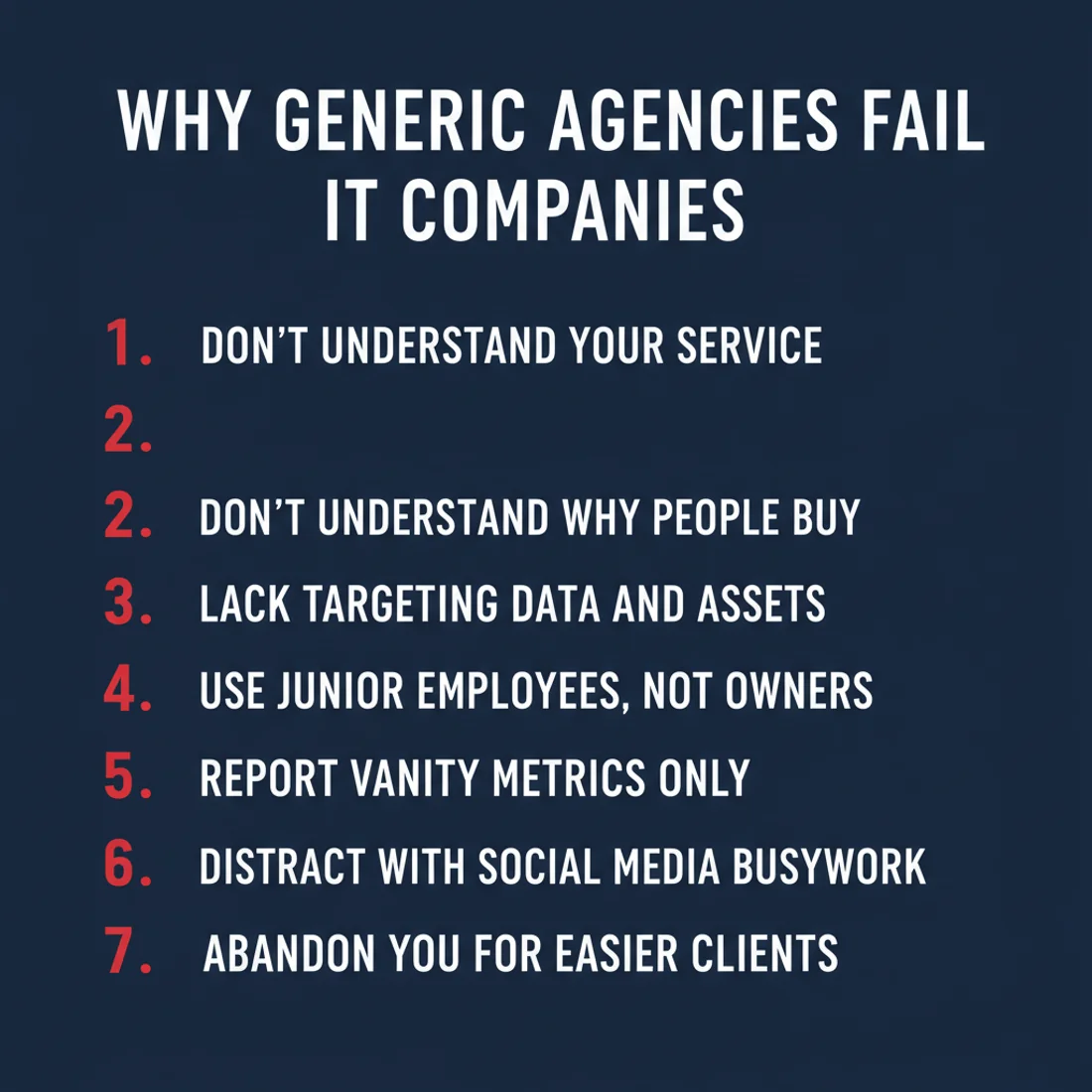
I need to be direct about this because it is the single biggest waste of money in the IT consulting industry. Generic agencies — the ones who work with dentists on Monday, restaurants on Tuesday, and IT companies on Wednesday — consistently fail to generate results for technology services firms.
The Seven Reasons Generic Agencies Fail
- They do not understand your service—Can they explain the difference between break-fix and managed services? Between co-managed IT and fully managed? Between MSP and MSSP? If not, they cannot market it.
- They do not understand why people buy—IT consulting prospects are not impulse buyers. They are married to their current provider and only start looking when something breaks that trust. Generic agencies do not grasp this.
- They lack targeting data—An agency that specializes in your industry has keyword lists, negative keyword lists, ad templates, landing page templates, and conversion benchmarks. A generic agency has none of this and will develop it using your budget.
- They use employees, not owners—The person running your campaign is typically a junior employee who has never run a business. They do not understand the urgency of lead generation or the value of each qualified prospect.
- They report vanity metrics—Rankings, impressions, click-through rates, website speed scores. None of these pay your bills. When you ask about actual leads, they change the subject.
- They distract with busywork—Social media posting, blog articles about general business tips, infographic design. All of it looks like activity but generates zero qualified IT consulting leads.
- They abandon you for easier clients—When an e-commerce company or real estate agent offers them a simpler engagement, your account gets moved to the back burner. IT consulting is hard — agencies without specialization will always prioritize easier industries.
Ben spent close to $100,000 with a generic agency before we started working together. They had him ranking for keywords nobody searched, built a website that looked identical to every other IT company in the state, and generated zero qualified leads. A hundred thousand dollars, zero results.
Key Takeaway: Generic agencies fail IT consulting firms because they lack industry expertise, targeting data, and understanding of the technology buyer's psychology. Always choose an agency that specializes in IT services and can demonstrate results with similar companies.
Building a Digital Marketing System That Scales Your IT Practice
A scalable digital marketing system for IT consulting combines local SEO, Google Ads, and content marketing into a compounding engine where organic visibility grows monthly, paid advertising optimizes through accumulated data, and each new client review strengthens the foundation that attracts the next client.
The goal is not to run a marketing campaign. Campaigns end. The goal is to build a system — a machine that generates qualified IT consulting leads consistently, month after month, with decreasing cost per lead over time.
What the System Looks Like After 12 Months
Tom, one of our MSP clients, added $400,000 in annual recurring revenue in a little over a year without paid advertising. Just organic traffic. That is the power of a compounding system. His Google Business Profile had dozens of strong reviews. His website ranked for high-intent local keywords. His content demonstrated genuine expertise. Every element reinforced the others.
- Organic search generating 5 to 15 leads per month—From local SEO, content clusters, and Google Business Profile optimization.
- Google Ads supplementing with immediate visibility—Exact-match campaigns targeting high-intent keywords, with conversion data feeding continuous optimization.
- Review count growing monthly—Each new client adds to your social proof, making it easier to win the next client. This is the flywheel effect.
- Content library building domain authority—Each article you publish adds to your topical authority, making future content rank faster and higher.
- Cost per lead declining—As organic traffic grows, your reliance on paid advertising decreases. The system becomes more efficient over time.
Getting Started
You do not need to do everything at once. Start with your Google Business Profile and website. Add content clusters after the foundation is solid. Layer in Google Ads when you are ready to accelerate. Each quarter, evaluate what is working and double down on it.
The IT consulting firms that grow are not the ones who try the most marketing tactics. They are the ones who commit to a proven system and execute it consistently for twelve months or more. Marketing for IT consulting is not a sprint — it is a compounding investment that pays dividends for years.
Key Takeaway: Build a digital marketing system, not a campaign. Combine local SEO, Google Ads, and content marketing into a compounding engine where each month's investment strengthens every subsequent month's results.
Want Help Growing Your MSP?
If you want help getting inbound marketing dialed in for your MSP, I'd love to talk. Fill out our quick fit-check survey to see if we're the right match for each other — and if we are, you can book a call with me directly.

%20(1).avif)
.svg)