.png)


Why Most MSP Marketing Plans Fail Before Q2
Most MSP annual marketing plans fail within the first quarter because they are built around wishful thinking instead of market data, spread resources across too many channels simultaneously, and lack the phased structure needed to build momentum before scaling investment.
I talk to MSP owners every single week. The conversation in January usually sounds like "this is the year we get serious about marketing." By April, they have spent $15,000 on a generic agency, tried Facebook ads for two weeks, posted on LinkedIn a few times, and generated zero leads. The plan did not fail because marketing does not work. It failed because the plan was never realistic.
Here is the uncomfortable truth: 49 out of 50 MSPs never scale past one to two million a year. And one of the biggest reasons is that they never built a real marketing plan. They built a wish list. A real annual marketing plan starts with data — your market size, competitive landscape, and realistic growth targets — and sequences activities so that each quarter builds on the last.
The MSPs I work with who actually grow are the ones who resist the urge to do everything at once. They start with the foundation, prove it works, then expand. This article is the exact framework I walk MSP owners through when they are building their annual plan.
Key Takeaway: MSP marketing plans fail because they try to do too much too soon without market data or phased structure. A successful annual plan sequences activities so each quarter builds momentum for the next.
Setting Your MSP Marketing Budget Based on Growth Goals
MSP marketing budgets should be reverse-engineered from revenue growth targets using local search volume, realistic conversion rates, and client lifetime value to determine the minimum monthly investment required to achieve a specific number of new clients per quarter.
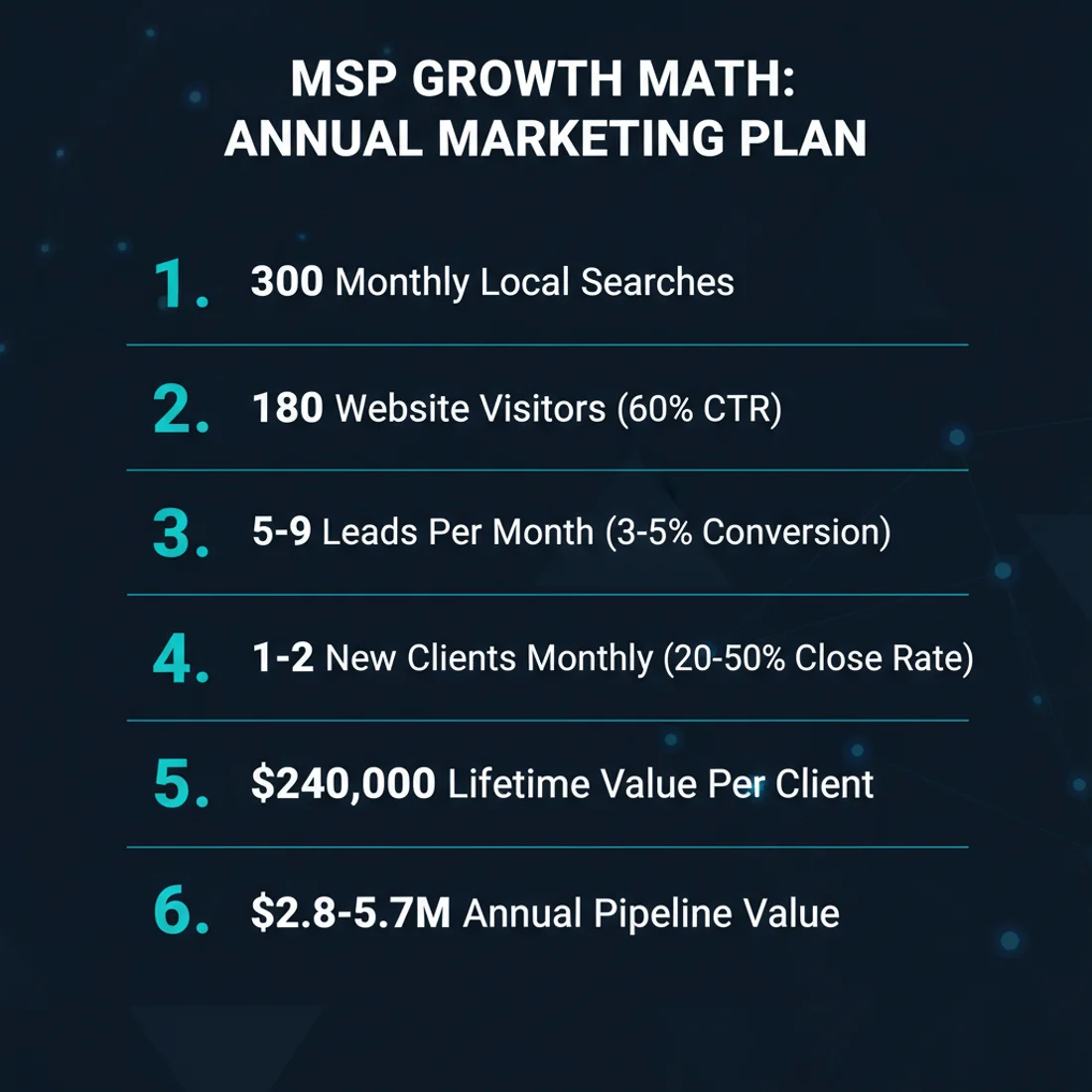
Before you decide how much to spend on marketing, you need to understand the math behind MSP lead generation. Here is the framework I use with every MSP we work with:
The MSP Growth Math
Local search volume — Typical Range: 100-500 monthly searches — What It Means: Total addressable demand in your market
Google local pack CTR — Typical Range: 60-70% of clicks — What It Means: Why ranking in the top 3 on Maps matters
Website conversion rate — Typical Range: 3-5% of visitors — What It Means: Percentage who become leads
Inbound close rate — Typical Range: 20-50% — What It Means: Far higher than cold outreach at 2-3%
Average contract value — Typical Range: $2,500/month — What It Means: Starting point for most MSP contracts
Client lifetime — Typical Range: 8 years average — What It Means: Clients rarely switch once onboarded
Client lifetime value — Typical Range: $240,000 — What It Means: $2,500 x 12 months x 8 years
How to Set Your Budget
If your market has 300 monthly searches and you can capture 60 percent through local SEO, that is 180 visitors. At a 3 percent conversion rate, that is 5 leads per month. At a 30 percent close rate, that is roughly 1 to 2 new clients per month — or 12 to 24 per year. Each worth $240,000 in lifetime value.
Now compare that to the investment. Local SEO typically costs $1,000 to $3,000 per month. Google Ads adds another $3,000 to $5,000 per month once you are ready to accelerate. A total investment of $4,000 to $8,000 per month to generate $2.8 to $5.7 million in lifetime pipeline value annually. The ROI is not even close.
For most MSPs building their first annual plan, I recommend starting at $3,000 to $5,000 per month total marketing spend for the first quarter, then scaling to $5,000 to $8,000 per month once your foundation is solid and you can measure what is working.
Key Takeaway: Reverse-engineer your marketing budget from growth targets. With a $240,000 client lifetime value, even modest marketing spend of $3,000-$5,000 per month can generate millions in pipeline value if invested in the right channels.
Quarter 1: Foundation — Google Business Profile, Website, and Reviews
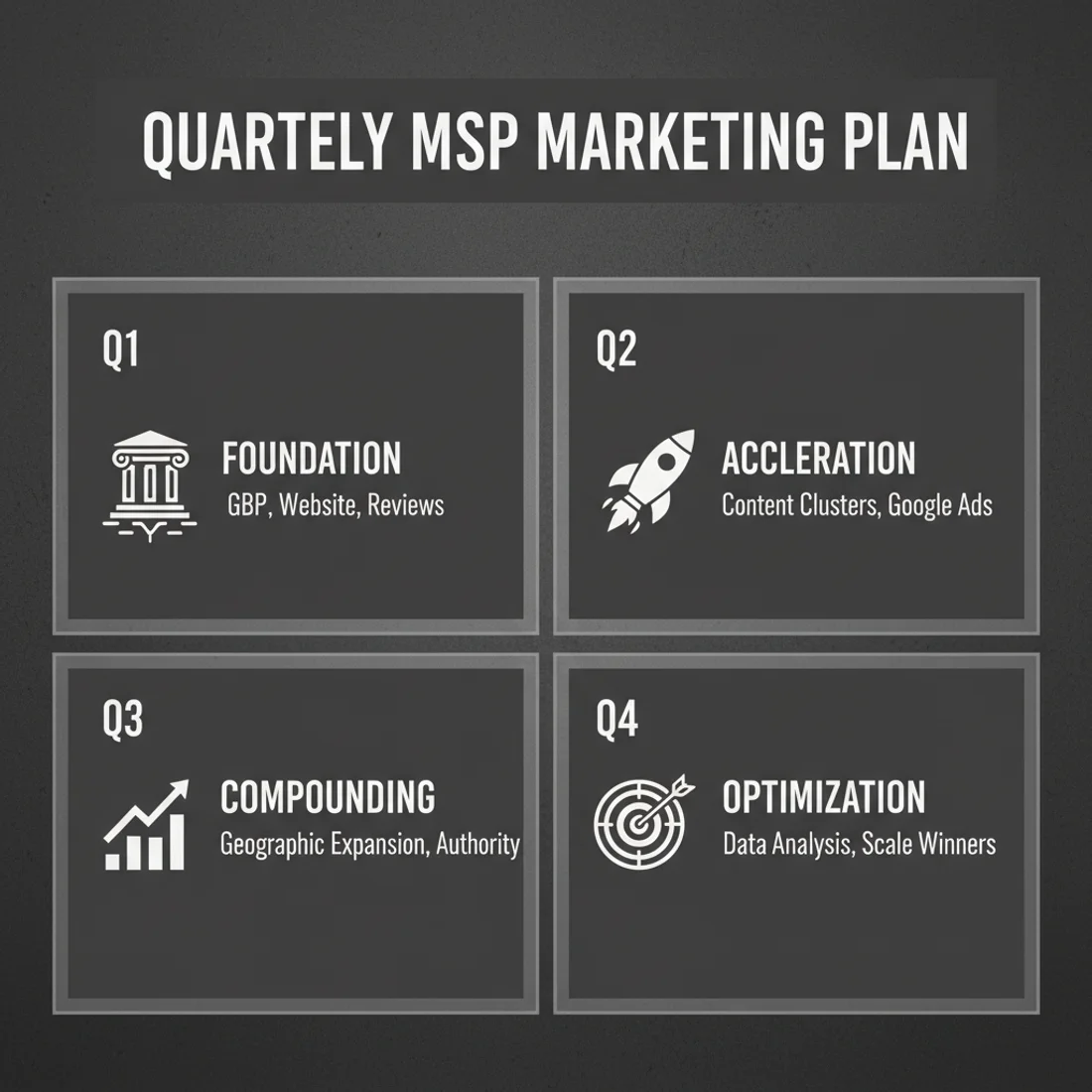
Quarter one of an MSP's annual marketing plan focuses entirely on building the conversion foundation by optimizing Google Business Profile, fixing the website to convert visitors into leads, and launching a systematic review generation program, because no amount of traffic matters if your digital presence cannot convert it.
This is where most MSPs want to skip ahead. They want to run Google Ads in month one. They want to start blogging immediately. But if your Google Business Profile has four reviews and your website looks like it was built in 2018, you are pouring water into a bucket with holes. Fix the bucket first.
Month 1: Google Business Profile Optimization
Your GBP is the first thing most prospects see. In a typical metro area, you will find 15 to 30 MSPs actively marketing online, but most of them have weak profiles. Here is what a fully optimized MSP Google Business Profile looks like:
Month 2: Website Conversion Optimization
Your website needs to do one job: convert visitors into leads. That means clear messaging about who you serve and what problem you solve, dedicated pages for each service, genuine proof through testimonials and case studies, and obvious calls to action on every page.
Everything is reverse-engineered from the ideal client profile. The MSP's target prospect determines website design, messaging, content, and positioning. If you do not know exactly who your ideal client is, your marketing will be generic, your messaging will be vague, and your close rate will be low.
Month 3: Review Generation Launch
Reviews are the currency of local SEO. A competitor with 100 reviews and a 4.8 rating is a fortress. A competitor with five reviews is an opportunity — and right now, you might be that competitor. Start a systematic process for asking every satisfied client for a review. The goal for Q1 is to add 10 to 20 genuine reviews to your profile.
Key Takeaway: Spend Q1 fixing your foundation — GBP optimization, website conversion, and review generation. Do not invest in traffic-driving activities until your digital presence can actually convert the traffic you receive.
Quarter 2: Acceleration — Content Clusters and Google Ads
Quarter two shifts from foundation building to active lead generation through a content cluster strategy that publishes four to six interconnected articles every two to three weeks and a targeted Google Ads campaign using exact-match keywords with a minimum five thousand dollar monthly budget.
By Q2, your foundation should be solid. Your GBP has fresh reviews and regular posts. Your website clearly communicates your value proposition. Now it is time to start driving traffic.
Content Cluster Strategy
Here is the approach: pick one topic that your ideal clients care about, write four to six in-depth articles about it over two to three weeks, publish them all within that window, then rest for one to two months before starting the next cluster. This builds topical authority in Google's eyes far faster than publishing random blog posts once a week.
Launching Google Ads
With your website now converting and content building your organic presence, Q2 is the right time to add Google Ads. Start with $3,000 to $5,000 per month. Use exact match and phrase match only — never broad match. Target high-intent local keywords like "managed IT services [city]" and "IT support [city]."
The key metric to watch is cost per qualified lead, not cost per click. A $50 click that generates a lead worth $240,000 in lifetime value is the best investment you will ever make. A $5 click from someone searching "free IT help" is worthless.
Key Takeaway: Q2 is about activating lead generation through content clusters and Google Ads. Publish 4-6 articles per cluster, launch ads on exact-match local keywords, and measure cost per qualified lead rather than cost per click.
Quarter 3: Compounding — Geographic Expansion and Authority Building
Quarter three leverages the momentum built in the first half of the year to expand into adjacent geographic markets where MSP competition is weaker, publish a second content cluster, and begin building domain authority through strategic partnerships and local citations.
By Q3, something exciting should be happening. Your organic rankings are starting to climb. Your Google Ads are generating consistent leads. Your review count is growing. This is the compounding phase — where each month's effort builds on the last.
The smartest move at this stage is geographic expansion. Most MSPs only target their immediate city. But the underserved suburb 30 minutes away with zero credible MSP competition is often a much better opportunity. One of our clients ranked first, second, and third across a 200-square-mile area on Google Business. That did not happen by competing in the most saturated part of their market.
Q3 Action Items
Expand into nearby underserved areas, publish a second content cluster, and strengthen authority through citations, backlinks, and case studies while optimizing ad performance based on real data.
Key Takeaway: Q3 is about expansion and compounding. Target underserved geographic markets, publish more content clusters, optimize ad spend based on real data, and build authority through citations and case studies.
Quarter 4: Optimization — Data-Driven Adjustments and Scaling
Quarter four focuses on analyzing nine months of marketing data to identify the highest-ROI activities, eliminating underperforming channels, scaling the investments that generate the best cost per qualified lead, and setting data-driven targets for the following year's marketing plan.
By Q4, you have real data. Not guesses, not industry benchmarks — your actual performance metrics. This is when you stop experimenting and start optimizing.
Planning for Year Two
Year two of your marketing plan should be significantly more aggressive than year one because you are building on a proven foundation. Your organic rankings are established. Your review count is growing. Your ad campaigns are optimized. The cost per lead should be declining while the volume increases.
Lee, one of our MSP clients, generated 14 inbound leads and closed 4 sales. The lifetime value of those four clients at $240,000 each is nearly a million dollars. That is not a one-year return — that is recurring revenue for the next eight-plus years, generated from a marketing investment of a fraction of that.
Key Takeaway: Use Q4 to analyze real data, eliminate underperforming channels, scale what works, and build a year-two plan based on proven results rather than assumptions. Your second year should compound on the first.
Measuring Your Annual Plan: KPIs That Actually Matter for MSPs
MSP marketing measurement must focus on business-outcome KPIs like qualified leads per month, cost per qualified lead, lead-to-close ratio, and client lifetime value rather than vanity metrics like website traffic, social media followers, or keyword rankings that do not correlate with revenue growth.
One of the biggest problems I see with MSP marketing is measurement. Agencies love to report vanity metrics — your traffic went up 40 percent, you rank number three for "IT solutions," your social posts got 200 impressions. None of that matters if the phone is not ringing.
The Only KPIs That Matter
Qualified leads per month — Target Range: 5-15 — Why It Matters: The primary output of your marketing system
Cost per qualified lead — Target Range: $200-500 — Why It Matters: Determines marketing efficiency and ROI
Lead-to-close ratio — Target Range: 20-50% — Why It Matters: Measures sales effectiveness on inbound leads
Customer acquisition cost — Target Range: $500-2,000 — Why It Matters: Total marketing spend divided by new clients
Client lifetime value — Target Range: $240,000+ — Why It Matters: Revenue generated per client over entire relationship
LTV to CAC ratio — Target Range: 10:1 or higher — Why It Matters: Should be minimum 4:1 for healthy growth
Google Business Profile views — Target Range: Growing monthly — Why It Matters: Leading indicator of local visibility
How to Track These Metrics
You need call tracking with a dedicated number for your marketing channels. You need form tracking on your website. And you need a simple system — even a spreadsheet — that tracks every lead from source to close. Most MSPs have no idea which marketing channel generated which client, and that makes it impossible to optimize.
Do not rely on your marketing agency to track these for you. Agencies have an incentive to make the numbers look good. You should have independent access to your Google Ads account, Google Analytics, and call tracking dashboard. Trust but verify.
Establish a three-month rolling average as your baseline. One bad month does not mean your plan is failing. One great month does not mean you can coast. Look at trends over quarters, not weeks.
Key Takeaway: Track qualified leads, cost per lead, close rate, and LTV-to-CAC ratio — not vanity metrics. Set up independent tracking for phone calls and form submissions, and evaluate performance on quarterly trends rather than monthly fluctuations.
Want Help Growing Your MSP?
If you want help getting inbound marketing dialed in for your MSP, I'd love to talk. Fill out our quick fit-check survey to see if we're the right match for each other — and if we are, you can book a call with me directly.

%20(1).avif)
.svg)