.png)


How to Market a Tech Company in a Crowded Digital Landscape
Marketing a tech company requires a fundamentally different approach than marketing traditional businesses because tech buyers research extensively online before ever contacting sales. Effective tech marketing combines search engine optimization, targeted content addressing technical pain points, conversion-optimized websites, and strategic paid advertising to reach decision-makers during their research phase.
If you're running a tech company—whether it's an MSP, software business, or IT services firm—you already know the irony: you're some of the most tech-savvy people in the world, yet marketing consistently feels like the hardest problem to solve. And when you try to outsource it, you're constantly working with under-equipped, under-motivated creative people at some local agency who don't understand your industry.
I've worked with hundreds of tech companies, and the pattern is always the same. They build something genuinely excellent, then struggle to get it in front of the right people. According to CompTIA's 2025 IT Industry Outlook, the technology services market is growing at 8% annually, which means more competition every year for the same buyers.
The companies that break through aren't doing anything magical. They've figured out how buying actually works: someone has a problem, they go online, they type something into Google, they research their options, and then they reach out to the companies that showed up and looked credible. Your entire marketing strategy needs to reverse-engineer that buyer journey.
Key Takeaway: Tech buyers research online before contacting you. Your marketing strategy must be designed around this research-driven buyer journey, not around pushing messages to people who aren't ready to buy.
How to Market Your IT Business: The Channel Mix That Works
Marketing an IT business effectively requires a specific channel mix: local SEO for geographic visibility, Google Ads for immediate qualified traffic, content marketing addressing compliance and security pain points, and a conversion-optimized website with team photos and social proof. Cold calling and cold email have consistently failed to scale for IT companies.
Let me run through the marketing channels and be honest about what actually works for tech companies:
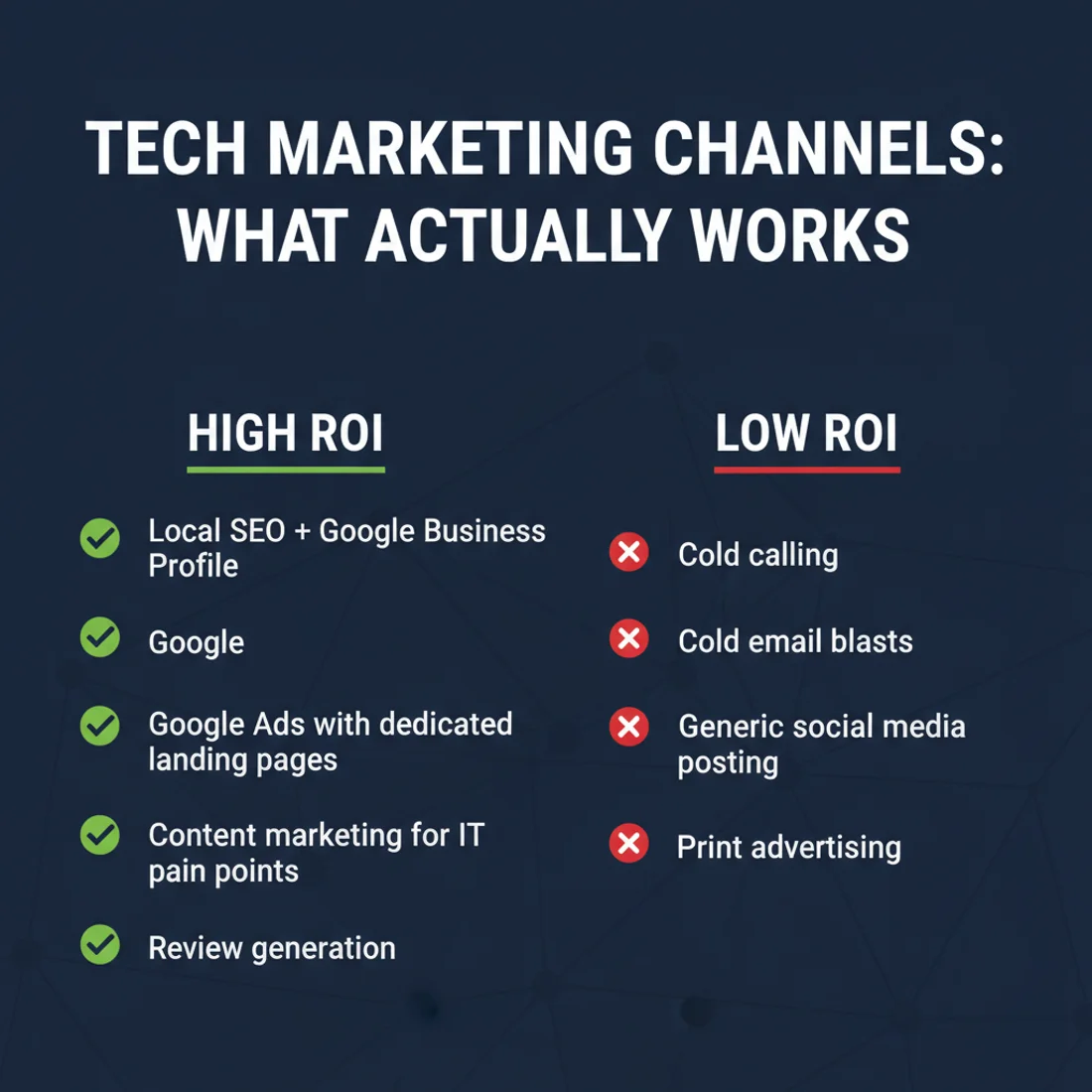
Local SEO + Google Business Profile — Effectiveness for Tech: Very High — Why: Tech buyers search locally first; proximity drives trust
Google Ads (PPC) — Effectiveness for Tech: High — Why: Captures high-intent search traffic immediately
Content marketing/blog — Effectiveness for Tech: High (long-term) — Why: Builds authority; answers questions buyers are researching
Social media — Effectiveness for Tech: Low-Medium — Why: Works for awareness, not direct lead generation
Cold calling — Effectiveness for Tech: Very Low — Why: Exhausting, doesn't scale, prospects research before engaging
Cold email — Effectiveness for Tech: Very Low — Why: Low response rates; feels like spam to technical buyers
Physical mail — Effectiveness for Tech: Niche — Why: Works for specific local campaigns, not at scale
Across hundreds of tech companies, I've seen exactly one that successfully implemented cold calling—and that owner still called me because he said cold calling was absolutely exhausting and impossible to scale. If the one success story says it's exhausting, that tells you everything.
The truth is, if you approach prospects before they're ready to buy, it doesn't work. What does work is being visible when they're actively searching. That's why SEO and Google Ads dominate for tech companies.
Key Takeaway: Invest in channels that capture demand (SEO, Google Ads, content) rather than channels that try to create demand (cold calling, cold email). Tech buyers won't respond until they're ready to buy.
How to Market an IT Company Through Search Visibility
Marketing an IT company through search visibility means dominating Google results for the specific services and locations your business covers. This requires optimizing your Google Business Profile, building location-specific website pages, creating content around IT pain points like cybersecurity and compliance, and earning reviews that build credibility with prospects comparing multiple providers.
Let me explain how the buying process works, because once you understand this, everything else clicks. Think about the last time you needed something—say your car's air conditioning broke. What did you do? You went online, searched for a mechanic near you, looked at reviews, checked their website, and called the one that looked best. Your prospects do the same thing when they need IT support.
The difference is that for tech services, the research phase is longer and more thorough. Smaller clients care about price and response times. Larger clients care about consistency and legacy systems. If you can't communicate that you provide what your target market needs, you need to fix that before spending a dollar on marketing.
Local SEO for Tech Companies
Local SEO drives results for IT companies because buyers search locally and choose providers that look credible. An optimized Google Business Profile, real photos, and strong reviews build trust quickly. Pair this with location-specific pages and consistent business information to improve rankings and conversions.
Paid Search for Immediate Results
While SEO builds over time, Google Ads provides immediate traffic from high-intent searches. The key is using dedicated landing pages for each service—never sending ad traffic to your homepage. Focus on keywords like “managed IT services [city],” “IT support for small business,” and “cybersecurity services near me.”
Key Takeaway: Your prospects are searching Google right now. Local SEO and Google Ads make you visible at the exact moment they're ready to evaluate providers. Everything else is secondary.
How to Market Technology Services With Content That Converts
Marketing technology services with content requires creating educational material that addresses specific IT challenges businesses face, including cybersecurity threats, compliance requirements, cloud migration complexity, and downtime costs. This content positions the technology company as a knowledgeable authority and captures organic search traffic from prospects in the early research phase of their buying journey.
Content marketing for tech companies isn't about writing generic blog posts. It's about answering the exact questions your prospects are typing into Google. When a business owner wakes up worried about ransomware, or their HR director is asking about HIPAA compliance, or their CFO wants to know what managed IT actually costs—that's the content you need to create.
Here's a content framework that works specifically for technology companies:
The old way for tech companies to grow was to struggle for a decade, figuring out marketing themselves, or pay tens—even hundreds—of thousands of dollars to a marketing agency that doesn't understand the industry. The new approach is building a content engine that compounds, generating leads at a decreasing cost per acquisition over time.
Key Takeaway: Create content that matches each stage of the buyer journey—from problem awareness to provider comparison. This captures organic traffic and builds authority that compounds over months and years.
How to Market Technology Products vs. Technology Services
Marketing technology products differs from marketing technology services primarily in buyer expectations and sales cycles. Product marketing emphasizes features, integrations, and scalability with potentially global reach, while services marketing emphasizes trust, proximity, and ongoing relationships within a defined geographic area. Both require a strong digital presence but use fundamentally different conversion strategies.
I've seen this distinction trip up a lot of tech companies. If you're selling a software product, your marketing playbook looks very different from selling managed IT services:
Many tech companies sell both products and services. When I ran a four-to-five million dollar marketing budget across Europe and the US for a tech vendor, the approach was completely different for field marketing to MSPs versus demand generation for the software platform. The channel mix, content strategy, and conversion paths were separate programs.
For MSPs and IT service companies specifically, the services playbook dominates. Your market is local, your relationships are long-term, and your marketing needs to communicate trustworthiness and expertise within a tight geographic radius.
Key Takeaway: Product marketing and services marketing require different strategies. If you're an MSP or IT services company, focus on the local trust-building playbook: team photos, reviews, local SEO, and proximity-based advertising.
How to Market a Software Company Alongside IT Services
Marketing a software company alongside IT services requires separate marketing motions for each offering, with dedicated landing pages, distinct content strategies, and different conversion paths. Companies that bundle software and services should position the software as a tool that enhances the service relationship rather than competing with it for marketing attention and budget.
I've seen tech companies try to market everything together on one website with one message, and it never works well. The software buyer and the services buyer have different needs, different research patterns, and different decision timelines.
When I joined a company that was selling a product directly to MSPs, I quickly realized that very few MSPs wanted to buy another tool. They wanted results. So we restructured the go-to-market: the software became an enabler of the service, not a standalone product. That reframing changed everything about the marketing.
Practical Steps for Dual-Offer Marketing
Start by separating your software and services into distinct landing pages with their own messaging, keywords, and calls-to-action. Run different campaigns for each offer so you’re not mixing audiences or intent in the same funnel. Position your software as a supporting tool that strengthens your services rather than competing for attention or leads.
Key Takeaway: If you sell both software and services, market them separately with different landing pages, content, and conversion paths. Position software as an expertise signal that feeds the services pipeline.
Building a Tech Marketing Engine That Compounds Over Time
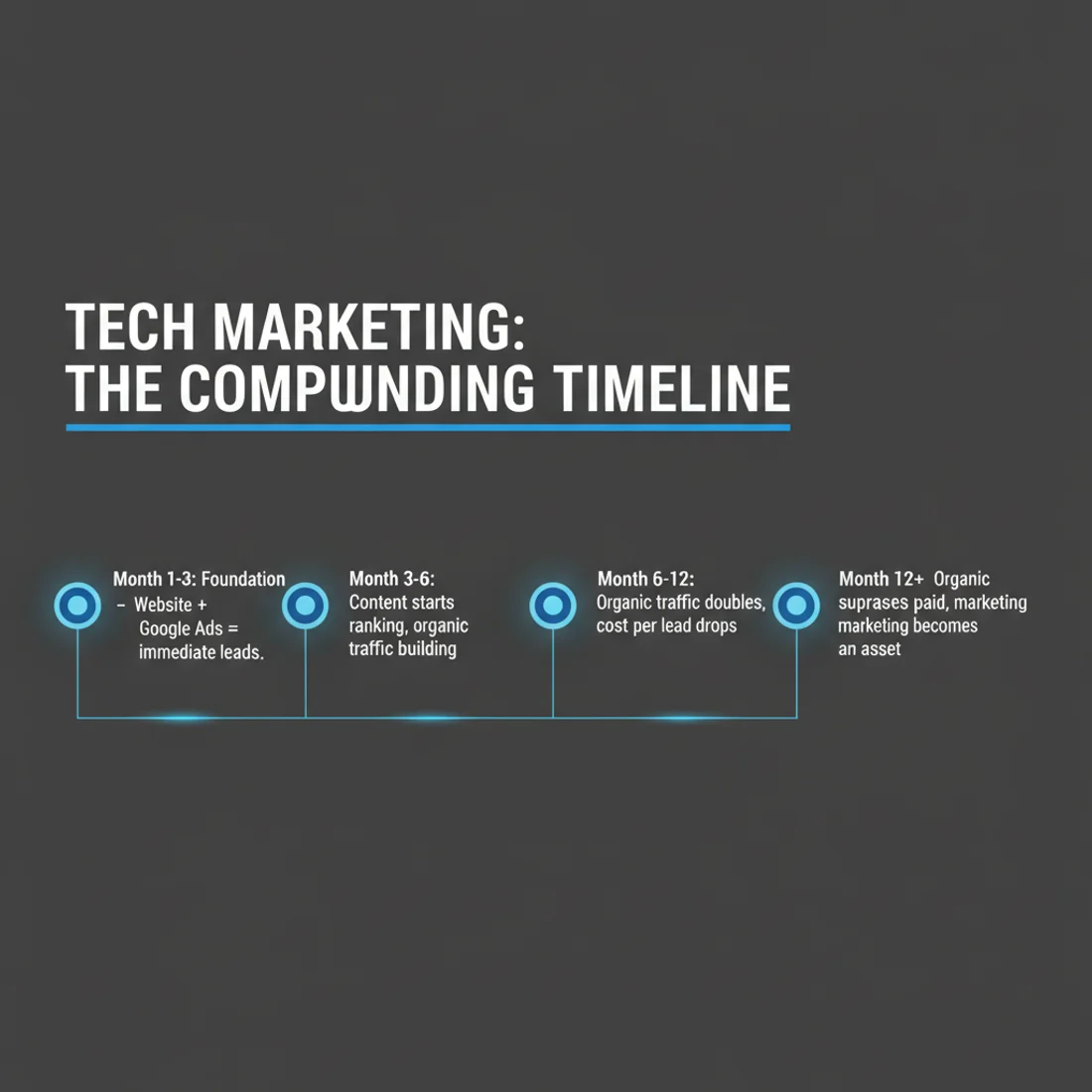
A compounding tech marketing engine combines SEO, content, and paid advertising into a system where organic traffic grows monthly while paid channels provide an immediate pipeline. Over 12 to 18 months, organic leads surpass paid leads in volume and cost effectiveness, creating a durable competitive advantage that becomes more valuable as the market grows.
In the MSP industry specifically, sales and marketing are the problems to solve. And for that reason, I'm a big advocate of tech companies building their marketing capabilities—whether in-house or with a specialized partner—because it's the competitive moat that matters most.
Here's how the compounding works in practice:
Every little bit of profit over a million dollars a year increases your valuation by 3 to 5x, depending on your market. A tech company with a proven, repeatable lead generation engine is worth dramatically more than one that depends on the owner's personal network or sporadic referrals.
The companies that figure this out—and they are the minority—build something that competitors simply cannot replicate quickly. That's the real competitive advantage of investing in marketing properly.
Key Takeaway: Marketing investment for tech companies compounds over time. The first 3 months feel slow, but by month 12, organic leads surpass paid leads—and your company's valuation reflects that sustainable growth engine.
Get a Free Marketing Audit
Curious how your MSP stacks up? Our MSP Growth Fit-Check gives you an honest assessment in under 2 minutes. No fluff, just clarity.
Want Help Growing Your MSP?
If you want help getting inbound marketing dialed in for your MSP, I'd love to talk. Fill out our quick fit-check survey to see if we're the right match for each other — and if we are, you can book a call with me directly.

%20(1).avif)
.svg)