.png)


What Is MSP Marketing — And Why Most MSPs Get It Wrong
MSP marketing is a specialized approach to generating inbound leads for managed service providers through local SEO, Google Ads, and conversion-optimized websites. Unlike general B2B marketing, MSP marketing targets IT decision-makers in companies with 20-200 employees who are actively searching for outsourced technology management in their city.
Here's the brutal truth about MSP marketing: most providers get it completely wrong from day one. They try generic B2B tactics, waste thousands on broad Google Ads campaigns, or worse—they treat MSP marketing like selling consumer products.

I've worked with 150+ MSPs across four countries, and the pattern is always the same. MSPs below $50 million in annual revenue just don't invest in proper branding or marketing positioning. No personality, no attractive colors, no clear messaging. They look exactly like every other IT company in their market.
According to Channel Futures' 2024 MSP Market Survey, 67% of MSPs report that lead generation is their biggest growth challenge. Yet the same study shows that MSPs who invest in professional marketing see 3x faster growth rates than those relying purely on referrals.
The difference between MSP marketing and regular business marketing comes down to three factors:
- Local intent: Your prospects search for "IT support near me" or "managed services [city name]"
- Technical decision-making: Buyers need to understand complex IT concepts before trusting their infrastructure to you
- High-value, long sales cycles: Average MSP contracts are $3,000-15,000 monthly with 2-3 year commitments
Most MSPs try and fail at digital marketing because they approach it like any other business. But managed services isn't retail, SaaS, or even traditional consulting. The buying process, search behavior, and trust requirements are completely different.
Key Takeaway: MSP marketing requires industry-specific strategies that address local search intent, technical credibility, and longer decision cycles—generic B2B tactics will waste your budget.
What Is Digital Marketing for MSPs — And Why It's Different from B2C
Digital marketing for MSPs encompasses local SEO, targeted Google Ads, LinkedIn advertising, and content marketing specifically designed to attract business owners and IT managers searching for managed technology services. MSP digital marketing focuses on demonstrating technical expertise and local presence rather than mass market appeal.
Every MSP owner has heard the same advice: "You need to do digital marketing." But what they don't tell you is that MSP digital marketing operates by completely different rules than consumer marketing or even most B2B industries.
The fundamental difference is search behavior. When someone needs consumer services, they might search broadly and compare dozens of options. When a business needs IT support, they search locally, read extensively, and evaluate just 2-3 providers before making a decision.
According to CompTIA's IT Industry Outlook 2024, 78% of small businesses research IT providers online before making contact. However, 84% of those same businesses prefer to work with local providers they can meet face-to-face. This creates a unique digital marketing challenge that consumer-focused agencies can't solve.
Here's how MSP digital marketing differs from traditional approaches:
- Geographic targeting is everything: Your ideal client is within 50 miles of your office, not scattered across the country
- Technical content builds trust: Publishing guides about cybersecurity compliance or network monitoring proves expertise
- Relationship-first approach: MSPs sell ongoing partnerships, not one-time purchases
- Higher intent, smaller audience: Fewer searches but much more valuable prospects
Social media marketing exists for MSPs, but it's not Instagram influencer content. A normal person will never follow an MSP on social media for entertainment. Instead, MSP social media focuses on demonstrating thought leadership to business owners who might see your content and remember your company when they need IT help.
I've spent years testing different digital marketing approaches with MSP clients. The methods that work consistently are local SEO (ranking for "managed IT services [city]"), highly targeted Google Ads, and LinkedIn content that positions you as the local IT authority. Everything else is secondary.
Key Takeaway: MSP digital marketing succeeds through hyper-local targeting and technical authority building, not broad reach or consumer-style content marketing.
What Is Included in an MSP Marketing Plan? (Essential Components Guide)
An MSP marketing plan includes local SEO strategy, Google Ads campaign structure, website conversion optimization, content marketing calendar, lead nurturing sequences, and competitor analysis. Effective MSP marketing plans also define target market segments, messaging frameworks, and monthly lead generation goals with specific metrics for tracking ROI.
Building a proper MSP marketing plan isn't about throwing tactics at the wall. It requires understanding your market, your competition, and your ideal client's decision-making process. Most MSPs skip this strategic foundation and jump straight to tactics—which is why their marketing fails.
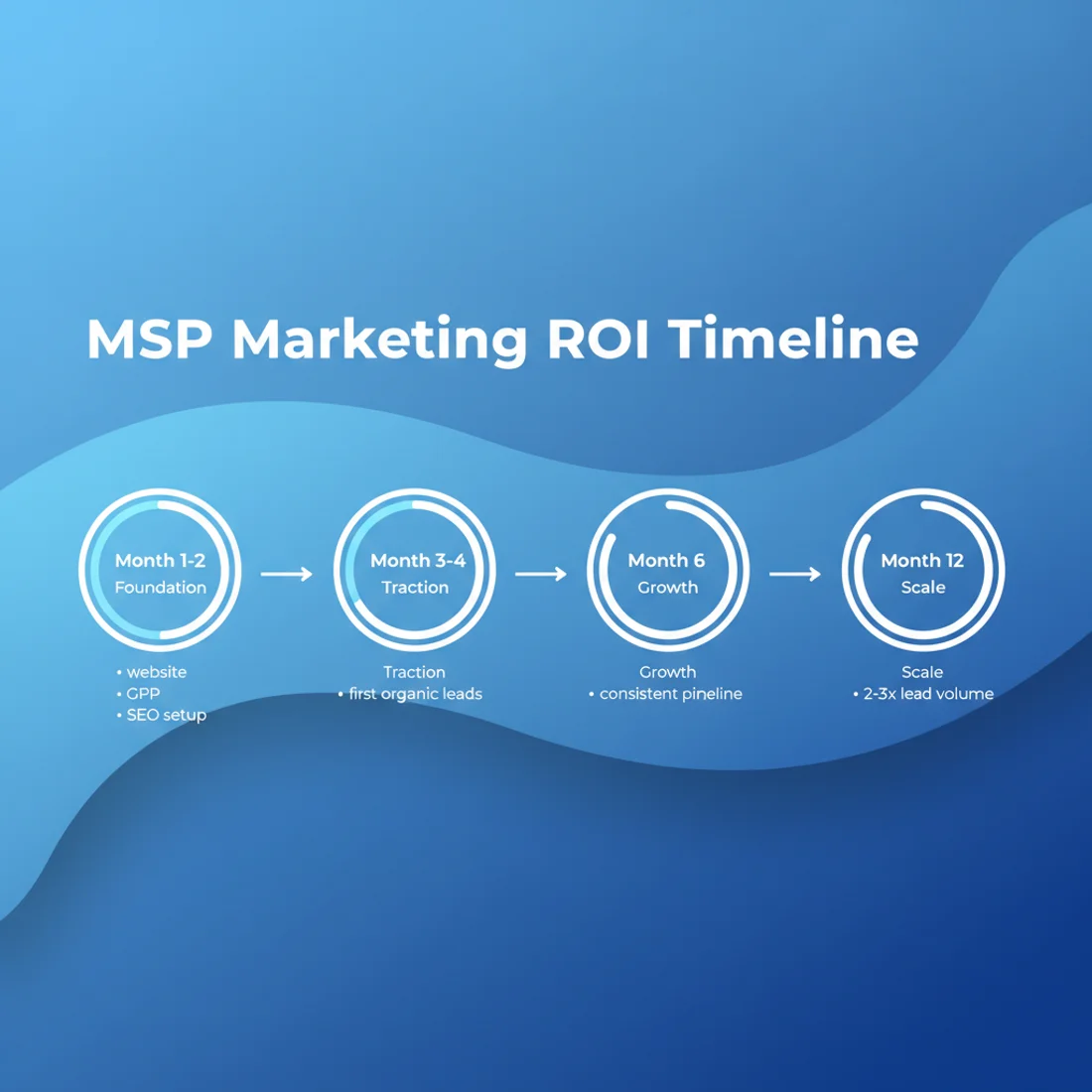
After working with hundreds of MSPs, I've identified the essential components that every successful MSP marketing plan must include:
Market Analysis and Positioning
You need to understand who you're competing against and how to differentiate. This means auditing the top 10 MSPs in your area, analyzing their websites, service offerings, and marketing messages. According to a Datto study, markets with 5+ established MSPs require 40% more marketing investment to achieve the same lead volume as less competitive areas.
Target Market Definition
Generic "small business" targeting doesn't work. You need to define specific industries, company sizes, and technology pain points. Are you targeting dental practices with compliance requirements? Manufacturing companies with aging infrastructure? Law firms that need security-focused IT?
Website and Conversion Strategy
Your website needs to convert visitors into leads, not just look professional. This includes service pages optimized for local SEO, case studies that demonstrate results, and lead magnets like IT assessments or cybersecurity guides.
- Local SEO foundation: Google My Business optimization, local keyword targeting, citation building
- Paid advertising strategy: Google Ads campaign structure, budget allocation, negative keyword lists
- Content marketing calendar: Blog topics that target high-intent keywords and demonstrate expertise
- Lead nurturing system: Email sequences that warm up prospects over 3-6 months
- Tracking and analytics: CRM integration, conversion tracking, monthly reporting
The marketing plan also needs to account for your capacity. If you can only handle 3-5 new clients per quarter, your marketing should generate qualified leads at that pace—not flood you with inquiries you can't handle.
Key Takeaway: MSP marketing plans must balance lead generation with service capacity, focusing on quality prospects rather than maximum volume to ensure sustainable growth.
What Does MSP Stand For in Marketing -- And Why It Matters for B2B
MSP stands for Managed Service Provider in marketing contexts, referring to companies that provide ongoing IT support, monitoring, and management services to other businesses. In B2B marketing, MSP designation signals a recurring revenue model, proactive service approach, and partnership-focused relationship rather than break-fix or project-based IT services.
Understanding what MSP means in marketing isn't just about the acronym—it's about recognizing a fundamentally different business model that requires specialized marketing approaches. When prospects search for "MSP" or "managed services," they're looking for ongoing IT partnerships, not one-time fixes.
The MSP model emerged as businesses realized that reactive IT support was too expensive and risky. Instead of calling for help after problems occur, companies pay monthly fees for proactive monitoring, maintenance, and support. This creates a $275 billion global market according to MarketsandMarkets research, with projected growth to $372.6 billion by 2028.
For marketing purposes, the MSP designation carries specific implications:
Traditional IT MarketingMSP MarketingSells solutions to problemsSells prevention of problemsProject-based pricingMonthly recurring revenueTechnical specifications focusBusiness outcome focusCompetes on priceCompetes on value and trust
When you market as an MSP, you're positioning your company as a strategic partner, not a vendor. This means your marketing messages need to address business continuity, productivity, and growth—not just technical capabilities.
The challenge is that many IT companies use "MSP" in their marketing without actually operating as managed service providers. They're still doing break-fix work or project implementations, but calling themselves MSPs because it sounds modern. This creates confusion in the market and dilutes the term.
Real MSP marketing focuses on demonstrating proactive value. Case studies show uptime improvements, security incident prevention, and cost savings over time. Marketing materials emphasize partnership, strategic planning, and business alignment rather than technical specifications.
We create local systems around MSPs to attract leads consistently. The longer you work with specialized MSP marketing, the larger your circle of influence becomes in your target market. It's about building sustained visibility and authority in your geographic area.
Key Takeaway: MSP marketing must differentiate between proactive partnership value and reactive technical services to attract clients seeking ongoing strategic IT support rather than project-based solutions.
Is Your MSP Marketing Actually Working?
Want to know if your MSP marketing is actually working? Take our quick Fit-Check Assessment -- honest feedback, zero sales pitch.

%20(1).avif)
.svg)