.png)





Why MSP Website SEO Is Different from Regular SEO
MSP website SEO is a specialized approach to search engine optimization that focuses on making managed service providers visible to local business owners actively searching for IT support, cybersecurity, and managed services in their specific geographic area.
I need to be blunt with you here: if you think SEO for your MSP works the same as SEO for an e-commerce brand or a SaaS company, you are going to waste a lot of money. I have seen it happen over and over again. MSPs come to me after spending $50,000 or $100,000 with generic agencies that treated their SEO like any other B2B campaign, and they have nothing to show for it.
The reality is that MSP SEO is fundamentally local. Your prospects are not searching globally for "best managed service provider in the world." They are searching for "IT support near me" or "managed services in Indianapolis." And that changes everything about how you should approach optimization.
Here is what most MSPs do not understand: the old-school approach to SEO — obsessing over domain authority, building backlinks, chasing high-volume national keywords — that is dinosaur-level MSP marketing. Google Maps is gaining market share while traditional organic results are losing it. The local pack gets 60 to 70 percent of all clicks, which means it gets double the clicks of ads and old-school organic results combined.
Key Takeaway: MSP SEO must be built around local visibility and Google Business Profile optimization, not traditional backlink-driven SEO strategies that work for national brands.
How Google Business Profile Drives MSP Leads
Google Business Profile optimization for MSPs involves strategic management of your business listing to appear in the local map pack when prospects search for IT services, directly generating phone calls and website visits from high-intent local searchers.
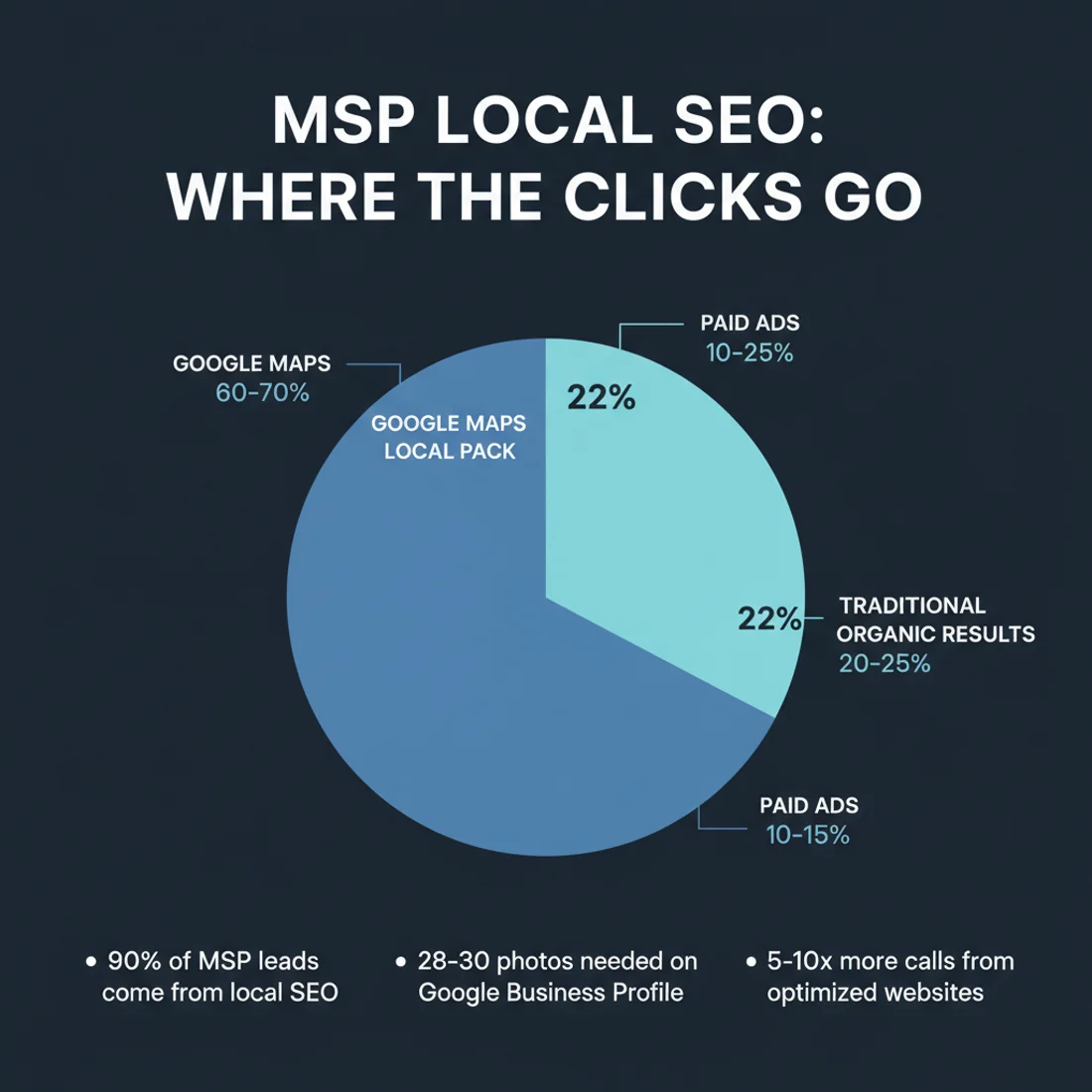
Let me share something that will change how you think about SEO entirely. Roughly 90 percent of the SEO leads our clients receive come from local SEO — specifically from their Google Business Profile. Not from blog posts, not from backlinks, not from technical on-page tweaks. From their Google Maps listing.
I know this because I have been tracking it across dozens of MSP clients for years. One of our clients in Indianapolis is ranking first, second, and third across a 200-square-mile area on Google Business. That is not a typo. Positions one, two, and three across an entire metro area. The result is a steady stream of inbound calls from business owners who need IT support right now.
Here is what you need to do with your Google Business Profile:
Key Takeaway: Your Google Business Profile is your most powerful SEO asset as an MSP. Optimizing it with 28-30 real photos, consistent review generation, and accurate service areas will drive more leads than any other SEO tactic.
The MSP Website Elements That Actually Affect Rankings
MSP website optimization requires a conversion-focused design with locally relevant content, fast load times, clear service pages targeting specific keywords, and mobile responsiveness that together signal authority and relevance to search engines.
Your website is not just a brochure. It is your 24/7 salesperson, and the difference between a website that is really optimized and one that is not can be five to ten times the amount of calls you get. I am not exaggerating. We have measured this across our client base repeatedly.
But here is the thing most MSPs get wrong: they think SEO is about some kind of wizardry. Hidden meta tags, keyword stuffing, fancy schema markup. The SEO wizardry is not as important anymore as it used to be. It is more about communication now. It is about developing an ideal client profile and reverse engineering what these prospects need to hear from you.
Service Pages Are Your Foundation
Every core service you offer needs its own dedicated page. Not a bullet point on a generic "services" page — a full, dedicated page with 800 to 1,200 words of content that speaks directly to the business owner's pain points. Your managed IT services page, your cybersecurity page, your cloud services page, your backup and disaster recovery page — each one targets different keywords and different buyer intents.
Local Signals Throughout Your Site
Your website needs to scream "local" to Google. That means your city and state in your title tags, your service area mentioned naturally in your content, your address in the footer of every page, and an embedded Google Map on your contact page. The team photo on your homepage is not just about design — it tells Google and your visitors that you are a real, local business.
Page Speed and Mobile Experience
If your website takes more than three seconds to load, you are losing prospects before they even see your content. Google measures Core Web Vitals and uses them as ranking signals. Compress your images, use a fast hosting provider, and make absolutely sure your site works perfectly on mobile because more than half of local searches happen on phones.
Key Takeaway: Forget SEO wizardry. Focus on dedicated service pages, local signals woven throughout your content, and a fast mobile-friendly experience — these fundamentals now drive more results than technical SEO tricks.
The Six-Month MSP SEO Roadmap
A strategic six-month MSP SEO roadmap prioritizes high-value service pages in months one through four, introduces secondary content topics in months two through four, and adds case studies with secondary market expansion in months four through six.
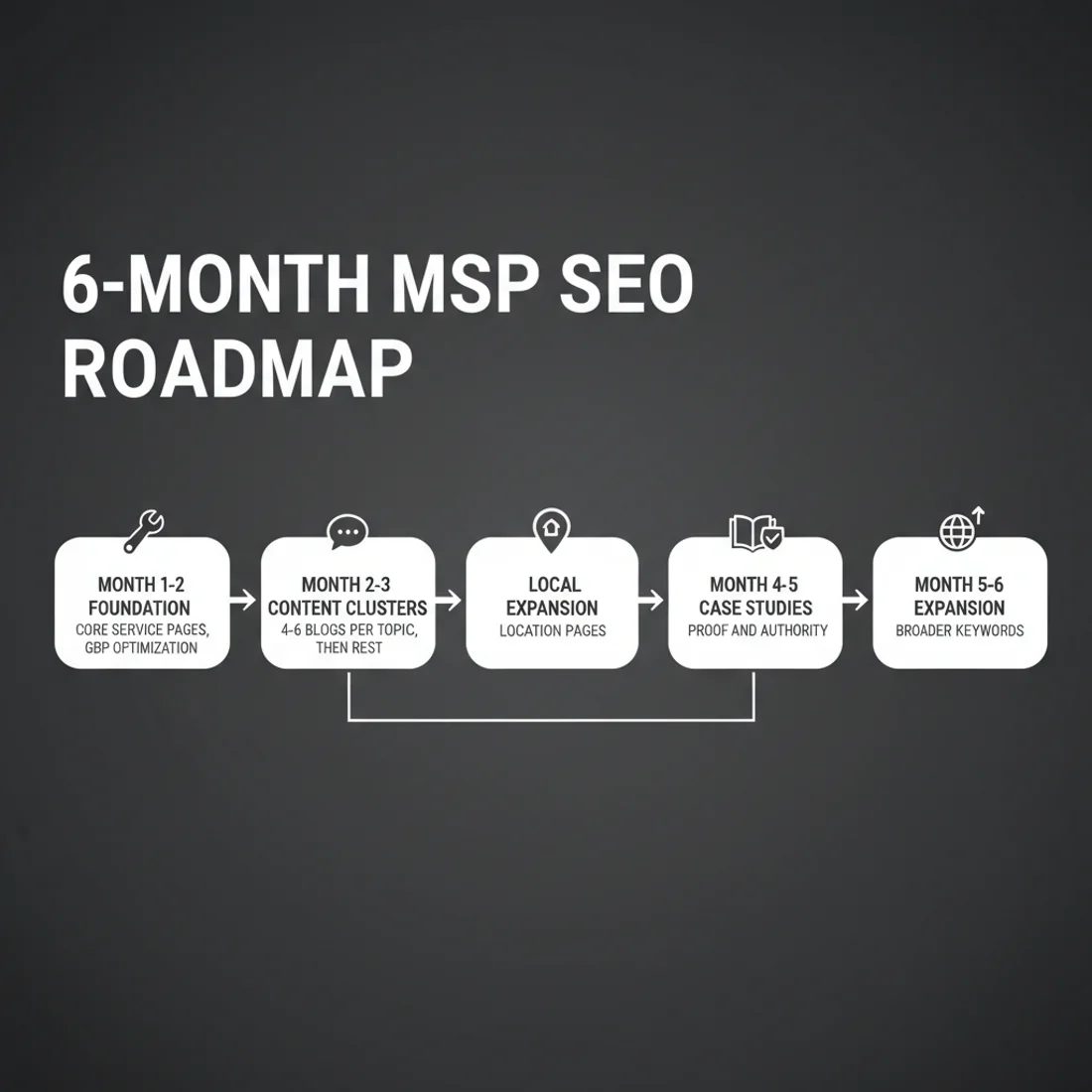
If you are wondering where to start, here is the exact roadmap structure we use with our clients. This is not theoretical — this is the same framework that took DivergeIT from 100 to 200 organic visitors per month to over 10,000. They are now a top-25 MSP in the United States.
Key Takeaway: Follow a phased SEO roadmap that starts with core service pages and Google Business Profile, then layers in content clusters, local pages, case studies, and market expansion over six months.
Keyword Strategy for MSP Websites
MSP keyword strategy begins with identifying high-intent local search terms that business owners actually use when looking for IT support, then organizing those keywords into topic clusters that build topical authority and drive qualified organic traffic.
Most MSPs approach keywords completely backwards. They look for high-volume terms first and try to rank for them. That is a losing strategy when you are starting out, and here is why: if you are a small MSP and you are new, you need to start with the easy wins, even if there is little to no search volume. The point is to build domain authority through keywords with low competition.
Our keyword strategy works like this: we identify what the market viability threshold is. If a keyword gets fewer than 40 monthly searches, it is not viable for driving meaningful traffic, but it is still worth targeting for building your domain authority. At or above 40 searches per month, you have a viable target.
High-Intent Keywords MSPs Should Target
Focus on keywords that show clear buying intent, such as “managed IT services [city],” “IT support for small business,” “cybersecurity services near me,” and “outsourced IT support pricing.” These searches come from decision-makers actively looking for a provider, not just browsing information. Prioritize local and problem-based terms first, as they convert faster and help build early domain authority.
The Content Cluster Approach
Once you have your keywords, group them into clusters of 4 to 6 related terms. Write all the blog posts for one cluster, publish them, then let them rest for 1 to 2 months. This prevents Google from flagging your site for spammy publishing behavior and gives the content time to index and settle into rankings. Then rotate to your next cluster.
We publish roughly 12 blogs per month for our clients. Most MSPs will not do more than 8 blogs a month or 2 blogs a week. That volume differential is a competitive advantage that compounds over time.
Key Takeaway: Start with low-competition keywords to build authority, target high-intent local and problem-based searches, and organize content into clusters of 4-6 related posts with rest periods between clusters.
Common MSP SEO Mistakes That Kill Your Rankings
The most damaging MSP SEO mistakes include confusing content creation with SEO strategy, relying exclusively on referrals instead of building online visibility, and hiring generic marketing agencies that lack MSP industry expertise.
There is a really big gap in understanding of what actually drives SEO results for MSPs versus what people think they should do. Let me walk through the biggest mistakes I see:
Thinking blogging is SEO — Why It Hurts: Making blogs is making content. Making blogs is not SEO. That is not how this works. Content supports SEO but is not SEO itself. — What to Do Instead: Pair content with technical optimization, local SEO, and Google Business Profile management.
Hiring a generic agency — Why It Hurts: Generic agencies do not understand that MSPs sell to local businesses, not enterprise or consumers. They waste your budget on wrong keywords and wrong channels. — What to Do Instead: Work with an agency that specializes in MSP marketing and understands local B2B dynamics.
Ignoring Google Business Profile — Why It Hurts: 60-70% of search clicks go to the local pack. If you are not optimized there, you are invisible to most prospects. — What to Do Instead: Treat your Google Business Profile as your primary SEO asset.
Chasing domain rating — Why It Hurts: I have seen websites with a domain rating of zero getting significant organic traffic. Domain rating is a third-party metric, not a Google ranking factor. — What to Do Instead: Focus on relevance, local signals, and content quality instead of chasing backlinks for DR.
Trying everything at once — Why It Hurts: MSPs spread themselves across social media, cold email, cold calling, SEO, and paid ads simultaneously. None of it gets enough attention to work. — What to Do Instead: Kill 80% of your channels. Focus on Google Maps, Google Ads, and SEO. That is it.
Key Takeaway: Stop treating blogging as SEO, stop hiring generic agencies, and stop ignoring your Google Business Profile. The MSPs who win at SEO focus on fewer channels and execute them properly.
How to Measure MSP SEO Results
Measuring MSP SEO success requires tracking local pack rankings across your service area, monitoring organic traffic trends, counting inbound lead volume from organic sources, and calculating cost per lead to compare against paid acquisition channels.
Rankings do not matter the way they used to. I know that sounds counterintuitive in a post about SEO, but hear me out. How often is the first-ranked result actually the thing you want to buy? Rarely. You go dig deep, you find a gazillion options, and the first option is almost never the one you choose. What matters is being visible and being attractive enough that people want to contact you over your competitors.
Visibility is only 50 percent of the equation. The other half is making sure that people actually want to buy from you, because otherwise they will just contact one of your competitors instead. Here is what you should actually track:
One of our clients, Lee, got 14 leads and four sales in his first month after his optimized website went live. That is the kind of result that proper MSP website SEO produces when the foundation is right.
Key Takeaway: Stop obsessing over rankings. Track Google Business Profile engagement, organic traffic trends, lead source attribution, and cost per lead to measure whether your MSP SEO investment is actually working.
Want Help Growing Your MSP?
If you want help getting inbound marketing dialed in for your MSP, I'd love to talk. Fill out our quick fit-check survey to see if we're the right match for each other — and if we are, you can book a call with me directly.

%20(1).avif)
.svg)