.png)


How Many MSPs Are There in the US?
There are approximately 40,000 to 50,000 managed service providers operating in the United States as of 2026, according to estimates from ChannelE2E and industry analysts. This number includes companies of all sizes, from solo operators managing a handful of clients to large enterprises with hundreds of employees and thousands of endpoints under management.
This is one of the most common questions I get from MSP owners, and the answer matters more than you think. Understanding the size of the MSP market helps you gauge your competitive landscape, identify opportunities, and make smarter marketing decisions.
The challenge with pinning down an exact number is that there's no universal registry of MSPs. Different research firms use different criteria. Some count any IT company offering managed services, while others only count companies where managed services represent the majority of revenue. Channel Futures, Datto, and CompTIA each publish different estimates depending on their methodology.
What I can tell you from working with MSPs across the country is that in any given metro area, you're competing with 15 to 30 other MSPs for the same local businesses. When I analyze search volume for cities like Denver, the keyword "IT support" plus local variations typically shows around 720 combined monthly searches. That's 720 potential prospects actively looking for IT help in one city alone.
Key Takeaway: There are roughly 40,000 to 50,000 MSPs in the US, but your real competition is the 15 to 30 MSPs in your specific metro area fighting for the same local search traffic.
How Many Managed Service Providers Are There in the United States?
The total number of managed service providers in the United States ranges between 40,000 and 50,000, with the market growing steadily as more traditional break-fix IT companies transition to the managed services model. The US represents the largest MSP market globally, accounting for approximately 40% of worldwide managed services revenue according to Statista's 2025 market analysis.
Let me break down what these numbers actually look like by size:

Solo / micro (1-5 employees) — Estimated Count (US): 15,000-20,000 — % of Market: ~40% — Typical Revenue: Under $500K
Small (6-25 employees) — Estimated Count (US): 12,000-15,000 — % of Market: ~30% — Typical Revenue: $500K-$3M
Mid-size (26-100 employees) — Estimated Count (US): 5,000-8,000 — % of Market: ~15% — Typical Revenue: $3M-$20M
Large (100+ employees) — Estimated Count (US): 2,000-3,000 — % of Market: ~7% — Typical Revenue: $20M+
Enterprise MSP / national — Estimated Count (US): 500-1,000 — % of Market: ~3% — Typical Revenue: $100M+
The majority of MSPs are small operations. Most MSP owners I speak with run companies between $500K and $5M in annual revenue, with teams of 5 to 30 people. These are the MSPs that benefit most from investing in local marketing, because they're competing in tight geographic areas where visibility directly translates to revenue.
The market is also consolidating. According to Channel Futures, private equity acquisitions of MSPs accelerated significantly in 2024-2025, with over 200 MSP acquisitions reported annually. This means the number of MSPs is actually shrinking slightly at the top end, while new entrants keep the total relatively stable.
Key Takeaway: Most US MSPs are small businesses with under 25 employees. Understanding where you fit in the market helps you benchmark your growth and identify realistic competitive targets in your local area.
How Big Is the MSP Industry?
The global managed services market is valued at approximately $311 billion in 2026 and is projected to exceed $400 billion by 2028, according to Statista and Gartner research. The US MSP market represents roughly $120 to $140 billion of this total, driven by increasing cybersecurity threats, cloud migration demand, and the growing complexity of IT infrastructure that small and mid-size businesses cannot manage internally.
These are massive numbers, but what do they mean for an individual MSP owner? Let me put it in perspective.
If the US MSP market is $130 billion and there are 45,000 MSPs, the average revenue per MSP is roughly $2.9 million. But averages are misleading—the top 10% of MSPs capture a disproportionate share. Most MSPs I work with are well below that average, which actually represents an enormous growth opportunity.
Key Market Growth Drivers
Key Takeaway: The MSP industry exceeds $130 billion in the US alone and is growing at 12% annually. Cybersecurity, cloud migration, and IT staffing shortages are creating sustained demand that favors MSPs who can market themselves effectively.
MSP Market Size by Region and City
MSP market density varies significantly by US region, with major metro areas like New York, Los Angeles, Chicago, Dallas, and Atlanta having the highest concentration of MSPs and the most competitive local search landscapes. Smaller metros and suburban areas typically have fewer MSPs competing for local search traffic, creating opportunities for well-marketed providers to dominate their geographic niche.
When I analyze a new market for an MSP client, I start by looking at search volume and competitive density. Here's what a typical analysis looks like:
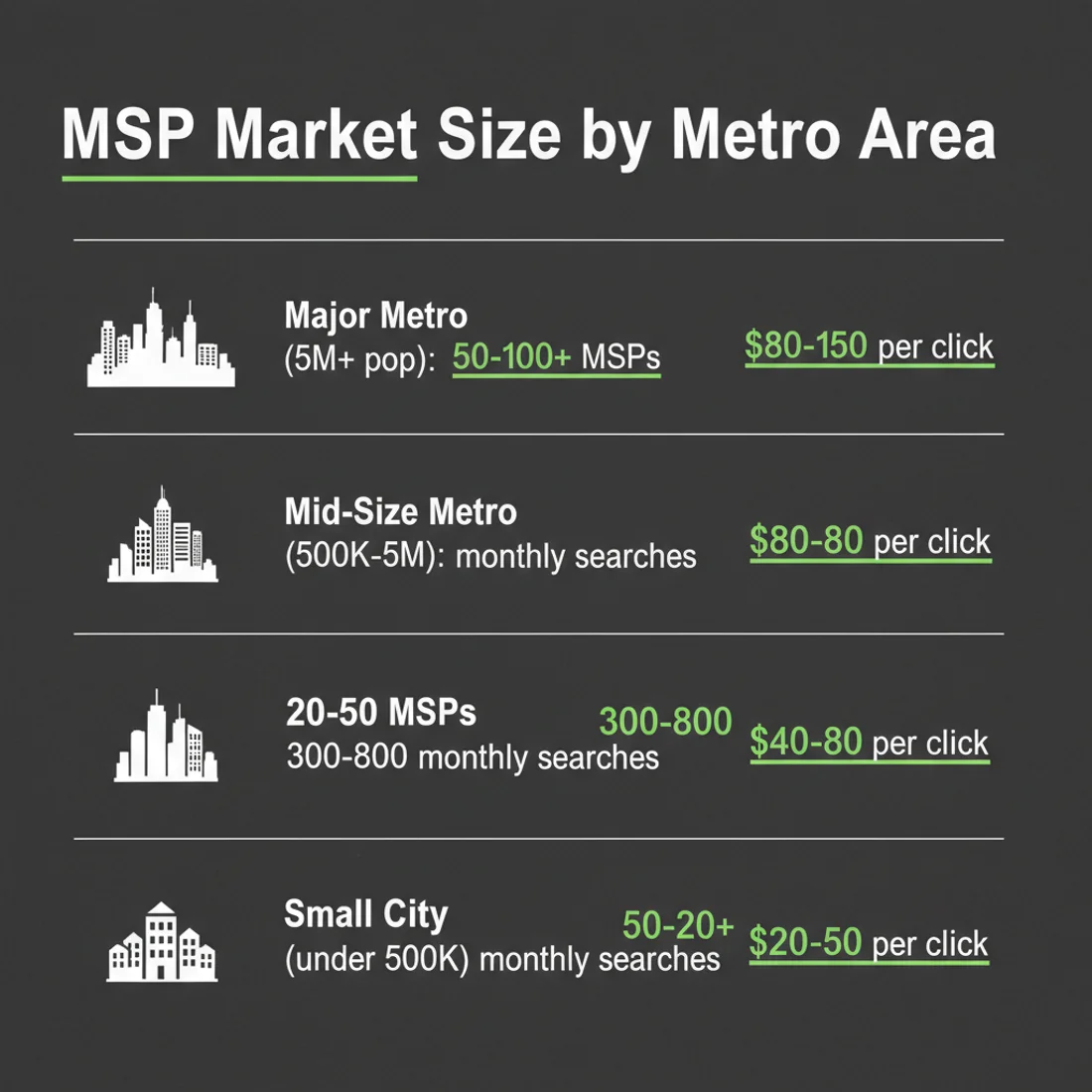
If you're in a small city and the market isn't big enough, the strategy is simple: we expand to multiple cities. Start getting leads from multiple areas. Build out your Google Business Profile and SEO presence in adjacent metro areas to increase your total addressable market.
The critical metric is your effective service radius. Most MSPs can't grow past 6 to 7 miles for on-site work, probably even less in a major city. But that's okay in dense areas because there are enough businesses within that radius. The MSPs that understand this geographic constraint and optimize for it outperform those trying to market nationally.
Key Takeaway: MSP competition varies dramatically by metro area. Analyze search volume and competitive density in your specific market before deciding your marketing strategy. If your local market is small, expand to adjacent cities rather than competing harder in a limited area.
MSP Industry Growth Rate and Future Projections
The managed services industry is growing at 12 to 14% annually through 2028, significantly outpacing the broader IT services sector's 6 to 8% growth rate. This accelerated growth is driven by increasing cybersecurity spend, cloud adoption, and the widening gap between business IT needs and available technical talent, creating a structural tailwind for MSPs who invest in scaling their operations and marketing.
Many entrepreneurs—most humans, really—struggle to think long-term. Everything must be now, everything must be fast. And that creates a fantastic opportunity for the MSPs who understand that building a marketing engine is a 6 to 12 month investment, not a 6-week sprint.
Here's what the growth trajectory looks like:
2024 — Global MSP Market (est.): $274B — US MSP Market (est.): $108B — YoY Growth: 11%
2025 — Global MSP Market (est.): $295B — US MSP Market (est.): $118B — YoY Growth: 12%
2026 — Global MSP Market (est.): $311B — US MSP Market (est.): $131B — YoY Growth: 13%
2027 — Global MSP Market (est.): $355B — US MSP Market (est.): $146B — YoY Growth: 14%
2028 (proj.) — Global MSP Market (est.): $405B — US MSP Market (est.): $162B — YoY Growth: 14%
The MSPs that are marketing effectively right now are positioning themselves to capture a disproportionate share of this growth. Every little bit of profit over a million dollars a year increases your company's valuation by 3 to 5x. An MSP growing at 20% with strong inbound leads is worth dramatically more than one growing at 5% from referrals alone.
Private equity firms understand this, which is why MSP acquisitions are accelerating. They're buying MSPs with strong recurring revenue and growth trajectories, then investing in marketing to accelerate further. If you're building your MSP with an eventual exit in mind, your marketing infrastructure is one of your most valuable assets.
Key Takeaway: The MSP market is growing at 12 to 14% annually through 2028. MSPs who invest in marketing now will capture a disproportionate share of this growth—and build significantly higher company valuations in the process.
What These Statistics Mean for Your MSP's Marketing Strategy
MSP market statistics directly inform marketing strategy by revealing competitive density, growth opportunities, and the return on investment for different marketing channels. With 40,000 to 50,000 MSPs competing nationally but only 15 to 30 competing in any given local market, the strategic imperative is clear: dominate your local search landscape before attempting to expand geographically.
Here's how to translate these market statistics into action for your MSP:
If You're Under $1M Revenue
If You're $1M-$3M Revenue
If You're Over $3M Revenue
The MSP industry is growing fast, competition is increasing, and the MSPs who invest in marketing infrastructure today will compound that advantage for years. The market statistics are clear—the question is what you do with them.
Key Takeaway: Your marketing strategy should match your MSP's size and revenue stage. Start with local dominance at any size, then layer in content and expansion as you grow. The market is big enough for every well-marketed MSP to thrive in their local area.
Want Help Growing Your MSP?
If you want help getting inbound marketing dialed in for your MSP, I'd love to talk. Fill out our quick fit-check survey to see if we're the right match for each other — and if we are, you can book a call with me directly.

%20(1).avif)
.svg)