.png)


How to Market Your MSP Business in 2026
Marketing an MSP business effectively requires a combination of local SEO, Google Ads, a conversion-optimized website, and content marketing that targets IT decision-makers searching for managed services within a specific geographic area. The most successful MSPs treat marketing as a system that generates predictable monthly leads, not as sporadic campaigns or referral-dependent growth.
The old way for MSPs to grow was to really struggle for a decade figuring out how to do all this stuff themselves, or pay tens—even hundreds—of thousands of dollars to a marketing agency that has zero understanding of the MSP industry. There's a better way now, and it starts with understanding what actually works.
Across hundreds of MSPs, I've seen one consistent pattern: the companies that grow predictably are the ones that invested in building a real marketing infrastructure. Not a flashy website that sits there. Not random social media posts. An actual system that puts them in front of the right prospects at the right time.
According to Datto's 2025 Global State of the MSP Report, 67% of MSPs cite lead generation as their biggest challenge. That means most of your competitors are struggling with the exact same thing. The opportunity is in doing what they won't.
Key Takeaway: MSP marketing must be a system, not a series of random tactics. The MSPs that grow predictably have invested in building repeatable lead generation infrastructure, not one-off campaigns.
How Do I Advertise My MSP? The Channels That Actually Work
Advertising an MSP effectively means investing in Google Ads with dedicated landing pages, local SEO for organic search visibility, and Google Business Profile optimization for map pack results. The closer your advertising targets prospects to your physical location, the higher your conversion rate will be, because proximity remains a critical factor in MSP client relationships.
Let me check this across all of our accounts: are there instances where we're not marketing close enough to the target? Because the closer you are to the target, the higher your conversion is going to be. If I was looking for an MSP and there were three ads—one from a company 2 miles away, one 10 miles away, and one 50 miles away—I'm clicking the one closest to me every time.
Here's what MSP advertising actually looks like when done right:
Google Ads (Your Fastest Path to Leads)
SEO (Your Long-Term Compounding Asset)
While Google Ads delivers leads immediately, SEO builds an asset that generates leads at a decreasing cost over time. Start with these SEO priorities:
Key Takeaway: Google Ads and local SEO work together—ads for immediate leads while SEO compounds in the background. Always target tight geographic areas and use dedicated landing pages for each service.
How Do I Promote My MSP Without Cold Calling?
Promoting an MSP without cold calling requires building inbound marketing systems that attract prospects who are already searching for managed IT services. This includes Google Business Profile optimization, content marketing addressing cybersecurity and compliance pain points, review generation strategies, and strategic partnerships with complementary vendors like accountants, insurance brokers, and software companies.
Most MSPs have tried cold calling or cold email at some point. Across hundreds of MSPs, I've seen exactly one that successfully implemented cold calling, and that owner still reached out to us because cold calling is absolutely exhausting and impossible to scale. It's the hardest way to generate leads, and the results are inconsistent at best.
One MSP owner I spoke with opened his company in 2022 and never really promoted himself—he only did subcontracting work. Another tried listing services on Angie's List but couldn't get them to promote the specific part of his business he wanted to grow. These stories are common because MSP owners default to tactics that feel safe but don't actually produce results.
Here's what works instead:
Google Business Profile — Time to Results: 1-3 months — Cost: Free (time only) — Sustainability: Very high
Review generation — Time to Results: 1-2 months — Cost: Free (time only) — Sustainability: Very high
Content / blog — Time to Results: 3-6 months — Cost: Low-moderate — Sustainability: Very high (compounds)
Google Ads — Time to Results: Immediate — Cost: $1,500-$5,000/mo — Sustainability: High (while funded)
Vendor partnerships — Time to Results: 2-4 months — Cost: Time + relationship — Sustainability: Medium-high
Local networking — Time to Results: 3-6 months — Cost: Time + events — Sustainability: Medium
The key insight is that inbound marketing—where prospects come to you—is fundamentally more sustainable and scalable than outbound approaches. When someone finds you through Google, they've already self-qualified as someone with a need. You're not convincing them they have a problem; you're showing them you're the best solution.
Key Takeaway: Cold calling doesn't scale for MSPs. Build inbound systems—Google Business Profile, content, reviews, and ads—that attract prospects who are already looking for what you offer.
How to Market Managed Service Provider Businesses: The Complete Playbook
Marketing a managed service provider business requires a structured playbook covering four phases: foundation (website and Google Business Profile), acceleration (Google Ads and initial content), compounding (SEO and content engine), and optimization (conversion rate improvement and expansion). Each phase builds on the previous one, creating a marketing system that becomes more effective and less expensive per lead over time.
Let me give you the complete marketing playbook I recommend for MSPs, broken into phases that match where you are right now:
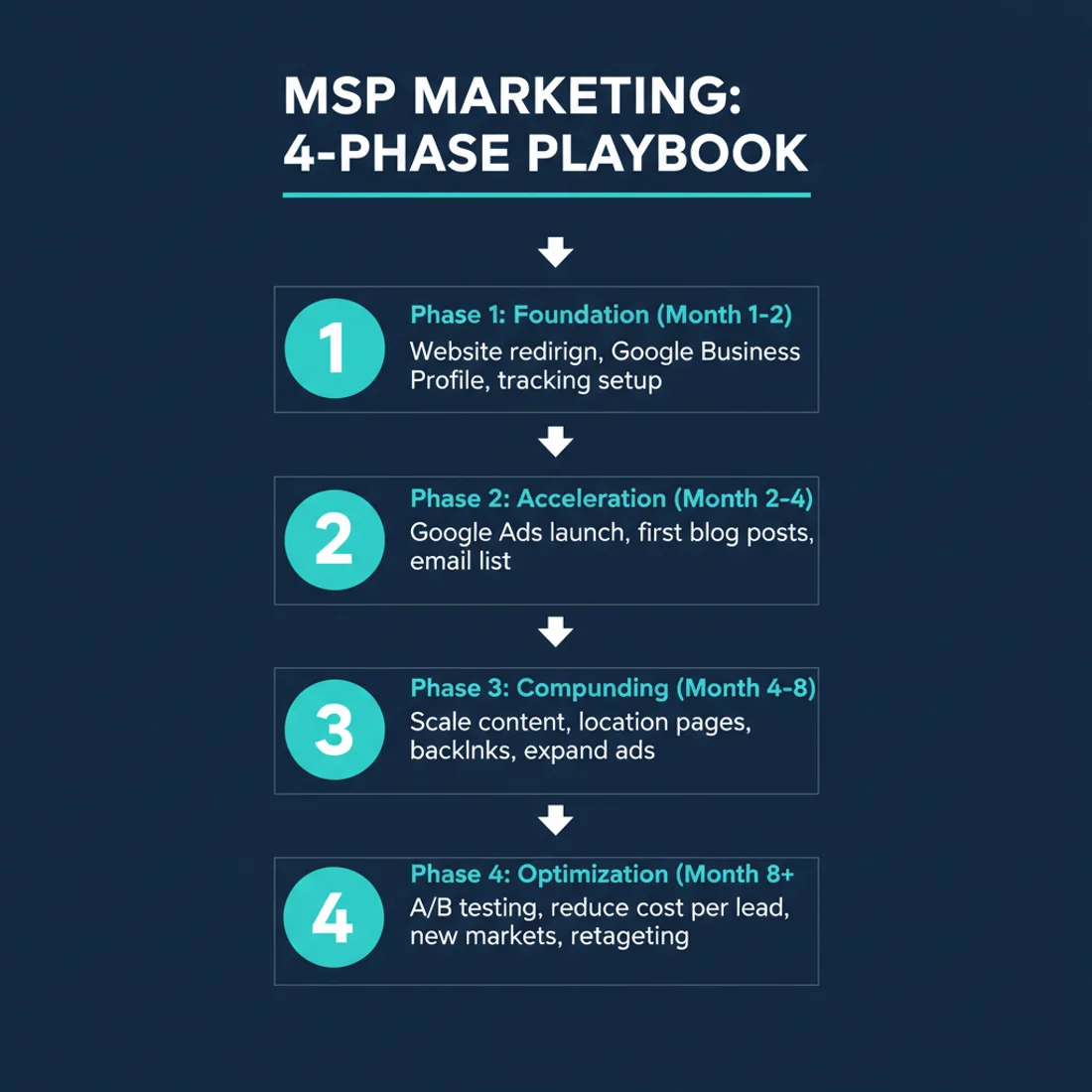
Phase 1: Foundation (Month 1-2)
Your website is the single most important marketing asset you own. If it doesn't communicate trust, expertise, and local presence within 5 seconds, nothing else matters.
Phase 2: Acceleration (Month 2-4)
Phase 3: Compounding (Month 4-8)
Phase 4: Optimization (Month 8+)
Key Takeaway: Follow the four-phase playbook: Foundation, Acceleration, Compounding, Optimization. Each phase builds on the last, and by month 8 your marketing system should be generating leads at a steadily decreasing cost.
The Biggest MSP Marketing Mistakes (and How to Avoid Them)
The most common MSP marketing mistakes include relying exclusively on referrals, using generic marketing agencies without MSP industry expertise, neglecting Google Business Profile optimization, sending ad traffic to the homepage instead of dedicated landing pages, and failing to track which marketing activities produce actual signed clients versus vanity metrics.
I see these mistakes constantly. Here are the top ones and how to fix them:

In the MSP industry, the problem is sales and marketing. Period. It's the reason most MSPs plateau. If you solve the marketing problem, everything else gets easier—hiring, retention, even the quality of clients you attract improves because you can afford to be selective.
Key Takeaway: Avoid the temptation to do everything at once. Build your MSP marketing systematically, starting with your website and Google Business Profile, then adding channels one at a time as each becomes effective.
Want Help Growing Your MSP?
If you want help getting inbound marketing dialed in for your MSP, I'd love to talk. Fill out our quick fit-check survey to see if we're the right match for each other — and if we are, you can book a call with me directly.

%20(1).avif)
.svg)